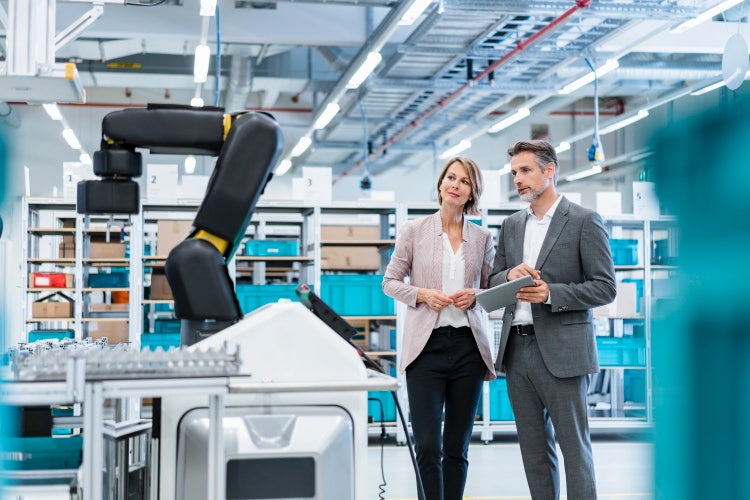
Manufacturing’s biggest shift in decades is happening in the cloud
Manufacturing solutions are moving to the cloud and if manufacturers aren’t paying attention, they could miss one of the biggest operational shifts the industry has seen in decades.
default
When production lines run 24/7, even a few seconds of downtime can become a million-dollar problem. Latency, cybersecurity, reliability, and real-time machine control made cloud manufacturing feel risky, maybe even reckless.
But according to Shaun Mitra, a IBM Partner Manufacturing and Supply chain transformation who is focused on manufacturing and digital transformation, one of manufacturing’s longest-held assumptions may no longer be true.
The cloud may actually be safer.
In Episode 144 of The Future of Supply Chain podcast, Mitra explains why cloud manufacturing solutions are becoming the foundation for how modern factories will operate in the years ahead. He argues that hyperscalers can now provide stronger security, resilience, and visibility than many traditional manufacturing environments can achieve on their own.
And if manufacturers aren’t paying attention, they could miss one of the biggest operational shifts the industry has seen in decades.
The factory floor isn’t disappearing
Conversations about the cloud for manufacturers are going far beyond software upgrades or infrastructure modernization. What’s emerging is a vision of deeply connected, AI-enabled, predictive operations that are capable of making real-time decisions business-wide.
This has nothing to do with factories moving entirely to the cloud. (They’re not.) As Mitra explains, “What it really means is cloud-based intelligence layered on top of local execution.”
Manufacturing is entering a hybrid era in which physical execution remains local while intelligence becomes centralized. The machines, programmable logic, and real-time controls still live on the shop floor. Meanwhile, analytics, orchestration, AI models, digital twins, and cross-plant visibility are increasingly moving to the cloud.
That shift changes what manufacturers can actually do with their data. In addition to running plants, they’re building connected manufacturing networks in which planning, production, logistics, maintenance, and execution all operate on the same data backbone.
“So as a COO or CFO of a company, you should be able to make real-time decisions,” Mitra reveals. That idea alone hints at how dramatically operations could soon change.
Take, for example, a global manufacturer who can instantly compare performance across plants. Maintenance failures can be predicted before they happen. Decision-makers can understand how a design change impacts production in near real time. And more important, planners can continuously optimize schedules, quality, and energy usage with AI.
These capabilities have existed in fragments for years. What’s changing now is their scale and impact. The cloud harmonizes global operations without forcing every plant to operate identically, something Mitra acknowledges is unrealistic in today’s manufacturing environments.
The real challenge isn’t technology
While technology is driving the cloud conversation, the challenges in adopting it have nothing to do with software. It’s about people, especially as experienced operators retire, and digital systems become more sophisticated.
“Technology is the easy part,” remarks Mitra. “People are the hard part.” Beneath the AI, automation, and cloud strategy is a very human reality: operators want to know how technology will help them do their jobs better.
“The question we need to answer is ‘What is in there for me?” he continues. “It’s just as important to focus on change management, helping teams understand why change matters and how it improves safety, efficiency, and decision-making.
The most successful manufacturers won’t just deploy new technologies. They’ll create environments where employees can make faster, smarter decisions with better tools and insights. The answer is augmentation, not replacement.
Ultimately, that approach may become the defining difference between companies that modernize successfully and those that struggle through transformation initiatives that never fully gain adoption.
The future factory may be closer than you think
Perhaps the most intriguing part of this emerging industry trend is that the “factory of the future” no longer sounds futuristic. It sounds close.
Factories remain physical. Humans remain essential. But decision-making becomes digital, connected, and increasingly intelligent. That’s the shift manufacturers should be paying attention to now.
“The factory truly becomes a part of a global intelligent manufacturing network,” Mitra says, “not just an isolated site.”
The companies building those connected, AI-driven operations today may become the ones everyone else is trying to catch tomorrow. And after listening to this conversation, it’s hard not to wonder: how far behind is too far behind?
Don’t miss the full conversation
Listen to the full episode to hear IBM’sShaun Mitra explain why manufacturing’s next major transformation is happening in the cloud and what leading manufacturers are doing now to stay ahead.

The Future of Supply Chain
The ideal podcast for supply chain, R&D, manufacturing, logistics, and operations executives to learn and share ideas and best practices with their peers.