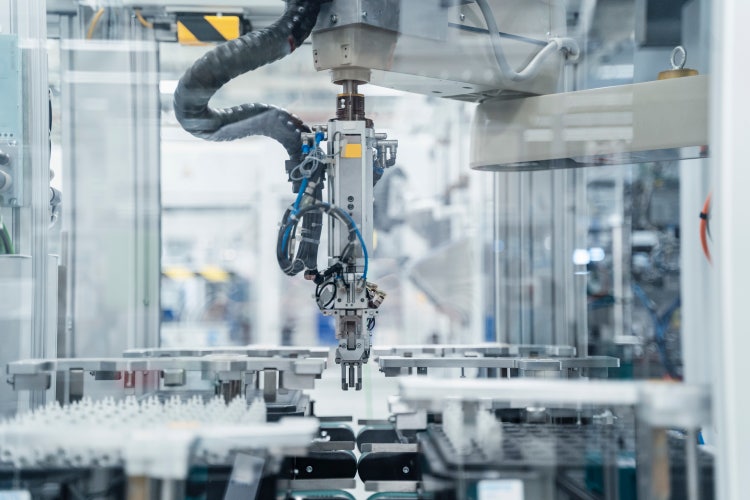
The Autonomous Enterprise orchestrates AI across every operation, from engineering and supply chain to aftermarket service, so that when conditions change, the entire business responds as one—with people setting direction, reviewing critical decisions, and staying in control.
If you run operations at an industrial manufacturing company, you already know the pressure. Supply chains are complex and more fragile. Customers expect configurable, service-wrapped products with shorter lead times. Energy and component costs keep shifting. And teams are still chasing exceptions across disconnected systems that were designed to record what happened, not act on what is happening right now. These are the gaps the SAP Autonomous Enterprise is built to close.
The pressure industrial manufacturing companies face today
Industrial manufacturers operate in an environment of compounding volatility. Component shortages, logistics disruption, and geopolitical risk can invalidate a production plan overnight. Energy cost volatility adds pressure to margins already challenged by commoditization and competition. At the same time, customers are shifting from standard catalogue products toward tailored equipment, subscriptions, and performance-based service models that require visibility across the full product lifecycle.
Siloed systems make that harder. Engineering data sits apart from supply chain planning. Manufacturing execution is disconnected from aftermarket service. Sustainability and Environmental, Social, and Governance (ESG) reporting is assembled manually from sources spread across the business. The result is a business that keeps moving but cannot always act as one.
According to an Industry Week report, 33% percent of executives at mid-sized industrial manufacturers responded that the lack of quality data or tools for planning and decision making is the most significant internal challenge to growing the business and simplifying processes.
What does “Autonomous Enterprise” actually mean?
An Autonomous Enterprise is not about removing people from business decisions. It is about changing what people spend their time on. Routine coordination, exception handling, and execution move toward AI agents so people can focus on the judgements, innovation, and customer relationships that require human thinking.
Consider a critical component delayed three weeks before a scheduled production run for custom equipment. Today, a planner checks the supplier portal, contacts procurement, reassesses production sequencing, updates the customer commitment, and flags field service impact. In an Autonomous Enterprise, agents detect the disruption, assess its impact across supply, production, and service, and recommend a resolution—executing it automatically when authorized
The operations manager reviews and approves. The business responds in minutes, not days. As SAP describes it: people set the direction. AI executes. This is a structural shift in how enterprise software is designed, with specific implications for industrial manufacturers running supply chain planning, production engineering, configure-to-order quoting, asset management, installation, and aftermarket service. SAP's Autonomous Enterprise vision explains how this applies across every function.

SAP solutions for Industrial Manufacturing
SAP has AI-embedded ERP software to drive growth, innovate sustainably, and run agile operations for industrial manufacturing.
Why industrial manufacturing is well-suited for Agentic AI
Industrial manufacturing operations are asset-intensive, process-interdependent, and highly complex in configuration and service requirements. That combination makes them well-suited to continuous, AI-driven optimization. Autonomous agents can help in several high-value areas:
- Supply exception management: Agents assess component shortages and logistics disruptions across the supply network, then identify alternate sourcing or production sequencing options before issues reach the shop floor.
- Configure-to-order quoting: AI agents accelerate complex equipment quotes by connecting configuration, pricing, approval, availability, historical sales, and installed base data.
- Production planning and execution: Agents monitor schedules, flag capacity or material conflicts, and coordinate adjustments across engineering, procurement, and the shop floor.
- Predictive maintenance and service: Agents use asset condition data to plan maintenance, dispatch technicians with full equipment context, and debrief service outcomes automatically.
- Sustainability and ESG reporting: Agents automate emission factor mapping, compliance data processing, and reporting workflows for continuous, auditable visibility.
The opportunity is not automation for its own sake. It is releasing experienced people from high-volume routine work so they can focus on decisions that genuinely require human judgement.
What makes this different from earlier AI approaches?
Industrial manufacturers have invested in AI for years: a predictive maintenance model here, a demand forecasting tool there, a quality algorithm on one production line. The frustration is that these tools improve one corner of the operation while leaving the bigger picture unchanged. They optimized in silos. The SAP Autonomous Enterprise is built on three foundations that change that:
First - Deep process and industry knowledge
SAP has encoded more than 50 years of process intelligence into the AI layer. Agents do not just read data; they reason within the context of how the business actually runs. For industrial manufacturers, that means understanding the relationship between a supply exception, an open production order, an engineering change, a service commitment, and a finance position—simultaneously.
Second - Semantically rich business data
SAP Business AI is built on a suite-wide semantic data model covering more than 7.3 million data fields. SAP Business Data Cloud helps harmonize engineering, manufacturing, and commercial data into a foundation that agents can reason across—the entire business - in real time.
Third - Enterprise-grade governance
Every AI action is auditable and traceable. For industrial manufacturers operating under CSRD, export control regulations, product compliance requirements, and expanding environmental reporting mandates, this is foundational. Speed and control are not a trade-off; governance is built in from the start.
Real results from industrial manufacturing companies
The shift to autonomous operations is already under way. Companies in the industrial manufacturing sector are demonstrating what is possible:
Maschinenfabrik Reinhausen GmbH
Germany-based Maschinenfabrik Reinhausen, a global leader in transformer regulation and grid technology, deployed SAP's Intelligent Product Recommendation application to transform its configure-to-order quoting process. Results: 80% less time to create a configured quote, more than 8,000 sales hours saved annually, and 20,000 quotes accelerated per year - increasing both revenue and customer satisfaction.
Daikin Industries
Daikin, a global leader in climate control, delivered an intelligent, end-to-end planning solution that transformed forecasting, collaboration and material management. The result - improved forecasting accuracy by over 25% across 34,000 material-plant forecasts and 350 branches.
KAESER KOMPRESSOREN SE
Germany-based compressed air systems manufacturer KAESER KOMPRESSOREN is working with SAP on adaptive production business processes. The SAP Business Agentic tender analysis and product recommendation accelerates RFQ qualification and materially improves quote accuracy.
Where to start
For business leaders evaluating what the Autonomous Enterprise means in practice, the most important question is not “How much AI should we use?” It is “Where in our value chain is the gap between signal and action costing us the most?”
For many industrial manufacturers, that gap appears in supply exception management, where a component delay is identified too late to prevent a production stoppage. It appears in quoting and configuration, where complexity adds days to a sales cycle customers expect to close in hours. It appears in change order management, where updates are not always accurately reflected through manufacturing and can create downstream rework, delays, or quality issues.
It appears in aftermarket service, where reactive maintenance erodes the margin on service contracts meant to drive recurring revenue.
SAP Cloud ERP and the SAP Autonomous Enterprise are designed to help industrial manufacturers address those gaps systematically—not with isolated point solutions, but with an integrated approach that compounds value across the full operation. Explore SAP's industrial manufacturing solutions to see how this applies across the full industrial manufacturing value chain.
SAP Industry
Manufacturing Built to Adapt
See how SAP Autonomous Suite helps industrial manufacturers simplify operations and grow sustainably.